
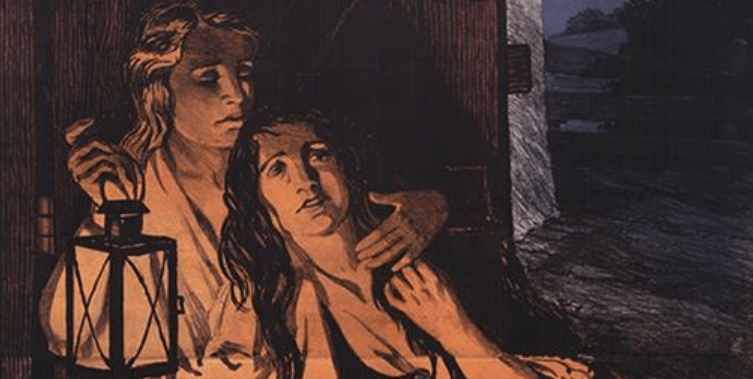
Among the Czech silent films I had yet to encounter was Tam na horách, a recently rediscovered work with considerable importance in the history of Czech cinema. Directed by Ukrainian-born Sidney M. Goldin shortly before his departure for the United States, the film stands out for pointing Czech filmmaking in a clear direction at a time when its identity was still taking shape. It also features actors who would soon become icons, such as Karel Lamač and a very young Anny Ondráková, not yet eighteen. Unlike Lamač, Ondráková plays only a minor role here, but it’s still fascinating to see her already involved in film production.
The story follows Václav (Karel Schleichert), who lives in a mountain village with his wife Hana (Běla Horská) and their two daughters: Maruška (Julietta Romona) and Jarmila (Anny Ondráková). Maruška, blessed with a beautiful singing voice, is in love with Toník (Alexander Zarubin). Their romance is shattered by the arrival of the painter Jaroslav Hanuš (Karel Lamač), who seduces Maruška and abandons her once she becomes pregnant. The scandal and heartbreak lead to Václav’s death and Maruška’s banishment from her village. She eventually finds refuge with another family and catches the attention of impresario Karel Suda (Antonín Vaverka), who provides her with musical training and launches her into high society. At her debut, she unexpectedly encounters Jaroslav, who fails to recognize her. Seizing the opportunity for revenge, Maruška ensnares him in marriage, only to reveal afterward that she despises him and wed him solely so their child would carry his name. The ending, however, shifts toward reconciliation, as the two reunite in Maruška’s native home—while Toník, left behind, happily marries her sister Jarmila.

Julietta Romona, who starred only in this film, proves an odd casting choice; she shows little in the way of charisma, screen presence, or acting skill, leaving one to wonder how she was selected at all. That aside, Tam na horách is noteworthy for containing many elements that would become staples of Czech cinema: a child born from a fleeting affair, the contrast between rural and urban life, and the theme of the country sweetheart abandoned for a city intruder. The film also highlights local color through folk costumes, festivals, and other rural details, while its depiction of bourgeois urban life feels flat and uninspired. Despite these shortcomings, the film was a success in its time, helping to shape the early trajectory of Czech cinema into the distinctive style we recognize today.
This article was originally published in Italian on emutofu.com




 Silent Film Era
Leave a comment