
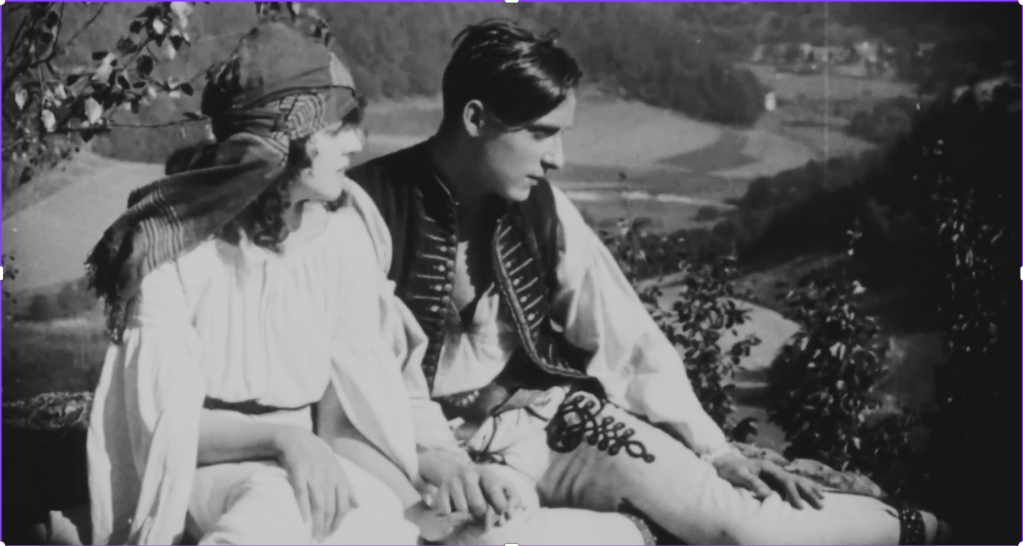
Let’s take a step back in time with Cikáni, a film I had long postponed watching because of its daunting subject matter and its two-hour runtime. Unfortunately, my fears were confirmed — once again, my obsession with completeness got the better of me, at the expense of my own patience.
The story begins in Venice, where Giacomo (Hugo Svoboda), a gondolier, is in love with the beautiful Angelina (Olga Augustová). She is seduced by a Czech nobleman, Count Valdemar Lomecký (Theodor Pištěk), who takes her back with him to Bohemia. Their relationship soon falls apart, and Angelina is cast aside along with her young son (Alfons Rasp). Desperate and without options, she abandons the child, who is eventually taken in and raised by Giacomo — now traveling with a group of gypsies, having followed the count into his own lands in search of revenge.
Years pass. The boy grows up while Angelina, broken and mad, wanders aimlessly through the countryside. The young man falls in love with a girl named Lea (Bronislava Livia), but tragedy strikes when she confesses that she has been assaulted by Count Lomecký. In a cruel twist of fate, the boy kills the man — not knowing he is his own father. His true parentage is revealed, and he inherits the title of count. Meanwhile, Giacomo falsely confesses to the murder and is executed. The spiral of tragedy continues: Lea, overcome by shame, takes her own life, and the new count abandons the land forever, heading south, never to return.

The only redeeming quality of this film, in my opinion, lies in its landscapes, particularly the Venetian settings — despite the clichéd gondolier protagonist, they retain a certain charm. Beyond that, Cikáni is a heavy-handed costume melodrama, a genre I have little tolerance for. At one point, Napoleone (Karel Faltys) and his troops even make an appearance in a baffling interlude that I struggled to place within the plot. To make matters worse, I had to watch the film without translation, and the verbose Czech intertitles were too much for my limited understanding.
The story itself is adapted from the novel by Karel Hynek Mácha, the leading figure of Czech Romanticism. Given his cultural stature, it was inevitable that his work would find its way onto the screen in the early years of Czech cinema.
This article was originally published in Italian on emutofu.com



 Silent Film Era
Leave a comment