

Alois Jirásek was one of the most important figures in the cultural awakening that eventually led to the birth of Czechoslovakia in 1918. A university professor, writer, and member of parliament from 1920 to 1925, he was nominated several times for the Nobel Prize, though never awarded it. Among his works, the one dearest to me is Staré pověsti české (1894), translated in english as Ancient Bohemian Legends, a collection of Czech folk tales written at a time when the country was still under Austro-Hungarian rule. My favorite was always the story of the famous Astronomical Clock and its creator, Hanuš of Růže. Jirásek’s deep knowledge of folklore shaped not only his retellings but also his original works. One such play was Lucerna (1905), a fairy-tale-like drama rooted in Czech tradition. Unsurprisingly, when the nascent Czech cinema looked to adapt national literature, Lucerna was chosen. Its popularity outlived the silent era, inspiring three further adaptations, the last in 1967.
The story begins with the much-anticipated arrival of the Princess (Andula Sedláčková) in a small town. Everyone rushes to welcome her — except the miller Libor (Theodor Pištěk). His family has long been forced to serve as lantern-bearers to the nobility, a duty he finds humiliating. Angered by his refusal, the Princess’s courtiers threaten to take away Hanička (Anny Ondra), the orphan he cares for and loves dearly, and to fell the sacred linden tree said to protect all living beings. The Princess compels Libor to escort her into the forest with his lantern, while her men set about destroying the tree. The local schoolteacher, Zajíček (Karel Lamač), tries to defend it, and Hanička magically merges into the linden to protect it. Meanwhile, Libor finds himself drawn to the beautiful Princess — until her companion (Antonie Nedošinská) reveals the danger at hand. He rushes back just in time to join Zajíček in a desperate defense of the tree. In the climax, the Princess herself intervenes, ordering her men to spare the linden. A divine light shines upon them, and Hanička is restored to the mortal world, falling into the arms of her beloved miller.
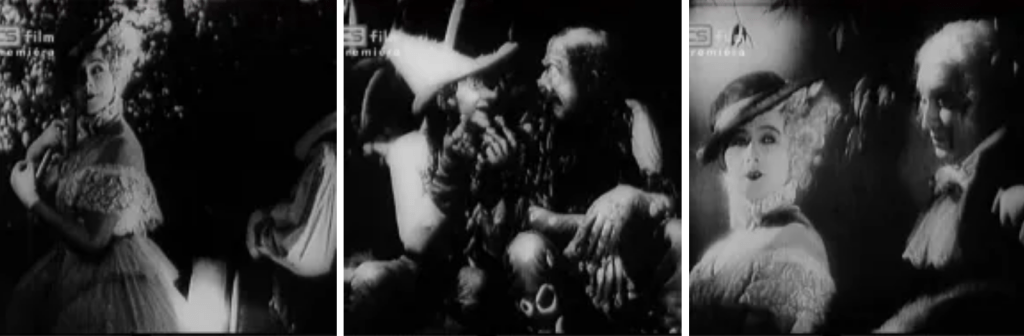
Folklore plays a vivid role in the film. Two vodník (water sprites), Michal and Ivan (Eman Fiala and Ferenc Futurista), appear throughout, mischievously frightening townsfolk. In Czech tradition, these spirits can range from tricksters to deadly beings who lure victims into drowning; here, they mostly provide comic relief. Most important of all is the linden tree, the national tree of the Czechs, symbolizing the survival of the people themselves.
Behind the camera, we find Svatopluk Innemann — who would soon start a successful directing career — and Otto Heller, later cinematographer of The Ipcress File (1965), for which he won a BAFTA. The casting is equally strong: Lamač himself as the schoolteacher, Ondra as the innocent orphan, Pištěk as the stubborn miller, and Sedláčková as the regal, striking Princess, enhanced by stunning costumes and makeup.
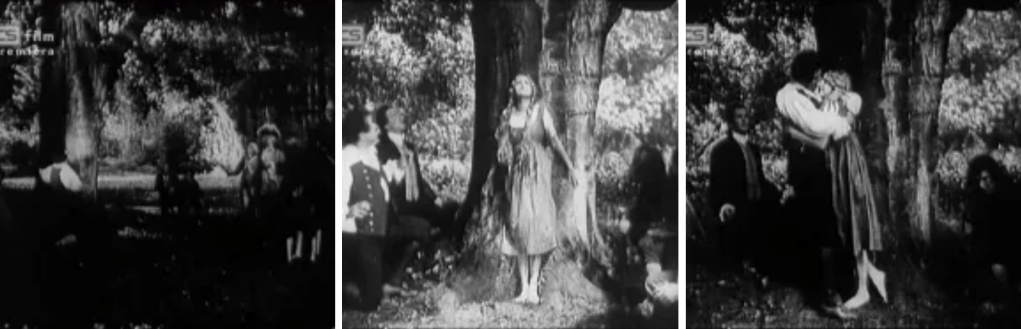
As for the film itself, I found it highly enjoyable, though not without flaws. Some may be due to my limited grasp of Czech: the intertitles are numerous, verbose, and untranslated, which made following every nuance a challenge. A few comic passages run longer than I would have liked. Yet overall, the film is beautifully crafted, with a rich fairy-tale atmosphere that lingers in the mind.
This article was originally published in Italian on emutofu.com




 Silent Film Era
Leave a comment