

Often hailed as the masterpiece of Czech silent cinema, Erotikon did not disappoint me in the slightest. While the story itself might not strike one as particularly original, what makes the film extraordinary is the way it is shot and the depth with which the actors inhabit their characters. Standing out above all is Ita Rina, the Slovenian actress who entered cinema almost by chance after being noticed as a Miss Europe candidate. Her career was short but brought her international acclaim.
On a rainy day, young Georg Sidney (Olaf Fjord) misses his train and takes shelter in the house of the local stationmaster (Karel Schleichert). The man must leave for work, leaving Georg alone with his daughter Andrea (Ita Rina). Passion takes over, and the two spend the night together. At dawn Georg departs, leaving Andrea behind to wrestle with her remorse. Soon after, she discovers she is pregnant. When she turns to Georg for help, she receives only money. Georg, in fact, is already involved with Gilda (Charlotte Susa), who herself is married to Hilbert (Theodor Pištěk). The child is born prematurely and dies, leaving Andrea devastated. Ashamed and grief-stricken, she runs away from home and wanders the streets until she narrowly escapes an attempted assault. Her savior, Jean (Luigi Serventi), risks his own life to defend her and, after a long recovery, marries her. But old ghosts resurface. In a piano shop, Jean befriends Georg, which inevitably leads to Andrea’s reunion with her former lover. Suspicion grows, and Jean asks Andrea to leave with him. Instead, she goes to Georg, intending to escape with him—only for Hilbert to arrive and kill Georg in revenge for the affair with his wife Gilda. Andrea, repentant, returns to Jean, who takes her back without demanding explanations.
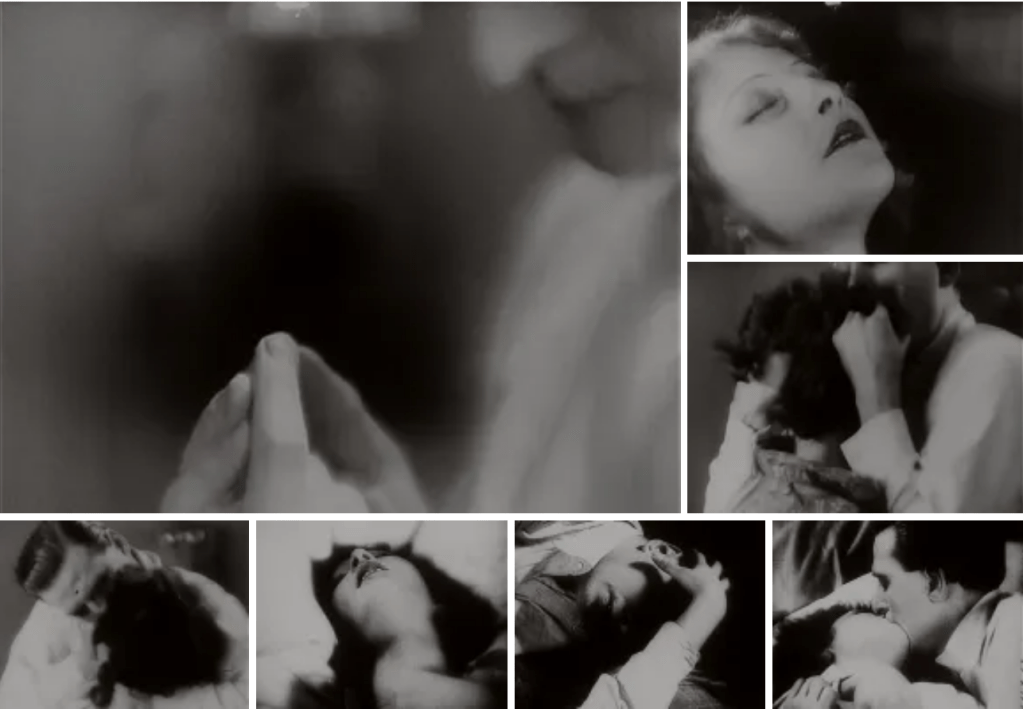
Erotikon is defined by its exquisite cinematography by Václav Vích: dynamic, fluid camerawork, and an eye for striking compositions that are rare in silent cinema. Ita Rina is often framed in close-up, her expressions carrying far more weight than the intertitles. In key moments, the rapid alternation of faces in the montage conveys unspoken emotions with remarkable intensity. While the climactic gunshot has clear parallels in other films of the time—such as Dcery Eviny (1928)—the most compelling sequence is unquestionably the night of passion between Georg and Andrea, conveyed through a series of rapid, pulsating cuts that perfectly express both the urgency of desire and the swiftness with which it consumes them.

The title Erotikon is evocative in itself, but where does it truly come from? Beyond its obvious reference to the erotic pull between the protagonists, attentive viewers will note that it is also the name of the perfume Georg gives Andrea at their first meeting—a token from his collection of fragrances, and one that seals their fateful encounter.
Adding a touch of national pride, one of the lead roles is played by “our own” Luigi Serventi. After a successful career in Italy, he moved to Germany in 1923 at the invitation of Gennaro Righelli for Bohème. According to Bernardini¹, he remained there until the end of the silent era, though his filmography shows occasional returns to Italian productions. His role in Erotikon likely stemmed from his reputation in Central Europe, which helped him secure a part in what was, after all, a Czech-German co-production.
For many viewers, Erotikon may be the only Czech silent film they know, but there are many more worth discovering—several of which we have reviewed here. Reviewing “masterpieces” is always daunting, as one feels there is little new to add to what has already been said. I hope, however, that this piece can serve as a starting point for rediscovering other local classics such as Milenky starého kriminálníka (1927), Batalion (1927), Píseň života (1924), Příchozí z temnot (1921), or Takový je život (1930).

¹ Aldo Bernardini, Cinema muto italiano. Protagonisti, Bologna, 2018.
This article was originally published in Italian on emutofu.com





 Silent Film Era
Leave a comment