
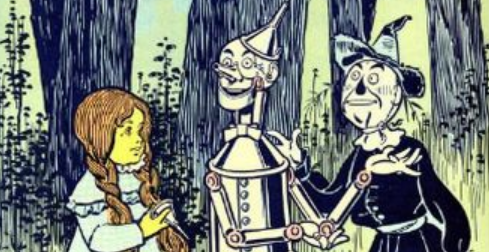
It was in 1900 that The Wonderful Wizard of Oz, written by L. Frank Baum, first appeared on American bookstore shelves. The book was an immediate success, capable of igniting the imagination of generations of children—and quite a few adults as well. Baum initially had no intention of creating a saga, but fate (and fan mail) intervened. When a young girl—sharing the name of the story’s heroine—visited his Chicago home to hand-deliver a letter, Baum casually remarked that if he received at least a thousand such requests, he would write new adventures featuring Dorothy, the Scarecrow, the Tin Woodman, and the Cowardly Lion. Unsurprisingly, he received far more letters than he had anticipated. In 1904, Baum returned to Oz with The Marvelous Land of Oz, the first of what would become a long and prolific series. In total, Baum wrote fourteen “canonical” Oz books, later expanded by devoted admirers after his death in 1919. (The story of how he came to write the sequel is recounted in the preface to the second book of the saga.)
Such an enormous success could hardly escape the attention of early cinema. As early as 1910, Oz made its screen debut in a short, fifteen-minute adaptation based on a musical that had premiered to great acclaim on Broadway in 1902—one to which Baum himself had contributed. Two sequels followed shortly thereafter, both directed by Otis Turner, though they are unfortunately now considered lost. Seeking greater creative control over his fantastical universe, Baum founded the Oz Film Manufacturing Company. Though short-lived, the studio managed to produce three films inspired by Oz: The Patchwork Girl of Oz, His Majesty, the Scarecrow of Oz, and The Magic Cloak of Oz, all directed by J. Farrell MacDonald. In truth, Baum’s first attempt to bring his world to the screen had already taken place in 1908 with The Fairylogue and Radio-Plays, a curious and ultimately unsuccessful hybrid combining live action, drawings, magic lanterns, and other visual techniques. Drawing not only from Oz but from several of Baum’s works, the production even featured the author himself in an on-screen appearance. Almost nothing of this ambitious experiment survives today.
The final silent-era echo of Oz, before Victor Fleming’s 1939 film permanently reshaped the public imagination, is The Wizard of Oz (1925), directed by and starring comedian Larry Semon, best remembered today for the presence of Oliver Hardy as the Tin Man.
The role of Dorothy was played, in chronological order, by Bebe Daniels, Violet MacMillan, and Dorothy Dwan—the second of whom was personally selected by Baum’s own company.
Enough background, then. It’s time to dive into the individual adaptations and see how the magical world of Oz evolved over its first twenty-five years on screen.
Before starting this project, I naturally read the entire Oz saga. Some sections are summarized rather than presented in their entirety. As for The Magic Cloak, it does not technically belong to the Oz universe.
Filmography
- 1908 – The Fairylogue and Radio-Plays – Francis Boggs, Otis Turner (*)
- 1910 – The Wonderful Wizard of Oz – Otis Turner
- 1910 – The Land of Oz – Otis Turner (*)
- 1910 – Dorothy and the Scarecrow in Oz (*)
- 1914 – The Patchwork Girl of Oz – J. Farrell MacDonald
- 1914 – His Majesty, the Scarecrow of Oz – J. Farrell MacDonald
- 1914 – The Magic Cloak of Oz – J. Farrell MacDonald
- 1925 – The Wizard of Oz – Larry Semon
Legend
- (*) Lost
- (*)? Probably lost
- (**) Preserved but unreleased / unavailable




 Silent Film Era